Having a website has become a must for most businesses, especially resorts. But simply having a website won’t make you outperform your competitors and turn visitors into guests; that’s where resort SEO comes in.
Users typically arrive at your webpages through search engines. This means that the higher you rank, the more searchers will visit your website, and subsequently, you get more bookings.
So, how do you get your hotel or resort website to rank higher on search engine results pages, and better yet, get referenced in AI recommendations? The answer is good search engine optimisation (SEO). This guide is your ultimate roadmap for boosting your website’s visibility and increasing direct bookings. It unpacks critical aspects of SEO, from on-page practices to off-page optimisation, technical SEO, local SEO, and much more.

What is Resort SEO?
SEO is the process of maximising website visibility and visits by creating and optimising high-quality and relevant content to improve the positioning of a website on search engine result pages (SERPs). These search engines include Google, Bing, and AI models like ChatGPT.
In the context of resorts and hotels, SEO refers to improving a website’s ranking in organic (non-paid) traffic. Organic search traffic is one of the most effective ways for people to discover and access online content, as it’s not sponsored, making it feel more authentic to readers.
Having good hotel SEO not only helps your site appear at the top of the SERPs, but also builds trust in your expertise amongst readers and ultimately, brand awareness. This doesn’t only apply to search engines, but also to social media and AI platforms, which are capturing an increasing amount of search traffic. You must optimise your site for these channels as well.
Note: When most people hear the term “search engine,” they immediately think of Google. While it has a dominant 79% market share, solely focusing on Google would be a mistake. You should also expand your SEO efforts to metasearch engines such as TripAdvisor and Kayak, as well as AI search engines like ChatGPT and Perplexity, to drive more qualified traffic.
Why Are Hotel And Resort SEO Services Important?
The resort and hotel industry is highly saturated, meaning there are many businesses in this field competing for the same customers. This makes it challenging to beat the competition. To outdo competing resorts, yours should get more direct bookings through its website. You need to capture a large chunk of the traffic, i.e., users who visit your site from a search engine result.
One of the best ways to increase traffic to your website is by ranking high on search engine result pages for a given query. Websites that appear on the first page of the SERPs receive more than 90% of the total traffic. For your resort website to rank among the top pages, you will need a well-executed SEO strategy that targets your core audience and builds trust.

SEO Strategies for Resorts: A Quick Overview
There are many ways to boost your website’s visibility and increase direct bookings, and as a resort SEO marketing agency, we’re happy to share some of these key strategies with you.
Here’s a quick overview of sure-fire tactics you can use to get your site ranking on the SERPs:
- Optimise Your On-Page SEO
- Work on Your Website’s Off-Page
- Strengthen Your Technical SEO
- Take Advantage of Google Search
- Leverage Local SEO for Hotels
On-Page SEO for Hotels and Resorts
On-page (or on-site) SEO involves optimising elements on a website to rank higher and capture more organic traffic from search engines. Some aspects that you can optimise include:
- Page titles
- Meta descriptions
- URL structure
- Heading tags
- Website content
- Image alt text
- Schema markup
- Internal linking
- Keyword usage
- Page speed
- User experience
On-site SEO for resorts and hotels aims to make it as easy as possible for both search engines and users to understand:
- What your resort website and each page are about
- If those pages are relevant to a search query or keyword
- If the pages are helpful and worthy of ranking well on a search engine results page
Below is a step-by-step strategy on how you can improve your resort’s on-page SEO.
1. Define Your Target Audience
One of the first steps to developing an SEO strategy for your resort is to define your target audience. Who are they? What do they like? What are their booking patterns for resorts?
Let’s say you run a beach resort, your core audience might be leisure travellers, families, and groups looking for a relaxed getaway. Alternatively, if you had a business hotel in the city centre, your target audience might be corporates looking for a short stay with Wi-Fi and workspaces.
Once you have identified your target customers, think about what they are likely to search for when seeking accommodations. For a beach resort, a potential search term could be “best resorts in X”. By targeting the right terms, you bring potential customers closer to your site.
2. Use The Right Keywords
Keywords are a crucial component of on-page SEO. These are the words and phrases that people use in search engines. They inform you on what to build your site content around.
If you know that your target audience is looking for an excellent birding or family experience in the area you service, it would be worth creating a blog post about “a list of birds you can find around Y” or “best things to do with your family in Z”.
Many keywords will apply to your hotel and location. That’s why it’s important to ensure that your targeted keywords align with search intent. This way, the content addresses what users are looking for, and search engines will rank your content as valuable and relevant.
More on the Types of Keywords
There are two types of keywords: broad and long tail. An example of a broad keyword is “hotel in Cape Town” (the big booking sites mostly rank high for these). A long tail keyword needs to be more specific, for example, “hotel for business travellers in Cape Town CBD”.
As search engines become better at understanding user intent, long-tail keywords are now less of a priority for ranking. Instead, medium-tail keywords are preferred. So, “hotel for business travellers in Cape Town CBD” would be answered just as well as “business hotel Cape Town”.
But this doesn’t mean long-tail keywords are no longer important. In fact, it’s the opposite. Longer search terms are often used by searchers who are much closer to making a decision. While the traffic may be less, the higher intent and lower competition give you an upper hand.

How to Conduct Keyword Research for Resort SEO
To develop a keyword strategy for SEO, you should target words and phrases centred around your resort’s main features and characteristics. These could be terms people use to describe the type of property they’re looking for, or to explain why they want to travel to your location.
Once you have identified keywords or phrases that you want to target, it’s good to validate these using a keyword research tool. These are Ahrefs, Google Keyword Planner, and Ubersuggest.
You’ll get insights into the average number of times a keyword is searched for each month and other valuable data. From this data, you can create content that aligns with your user intent.
3. Optimise Page Titles, Meta Descriptions, and URLs
The page title, meta description, and URL are crucial elements displayed in the search engine result pages. They play a big role in your resort’s overall SEO. Let’s take a deeper look.
Page Title
The page title is an HTML tag that appears on search engines and tells users what your website or web page is about. When users look up a phrase online, the search engine will provide them with a list of results that appear as snippets.
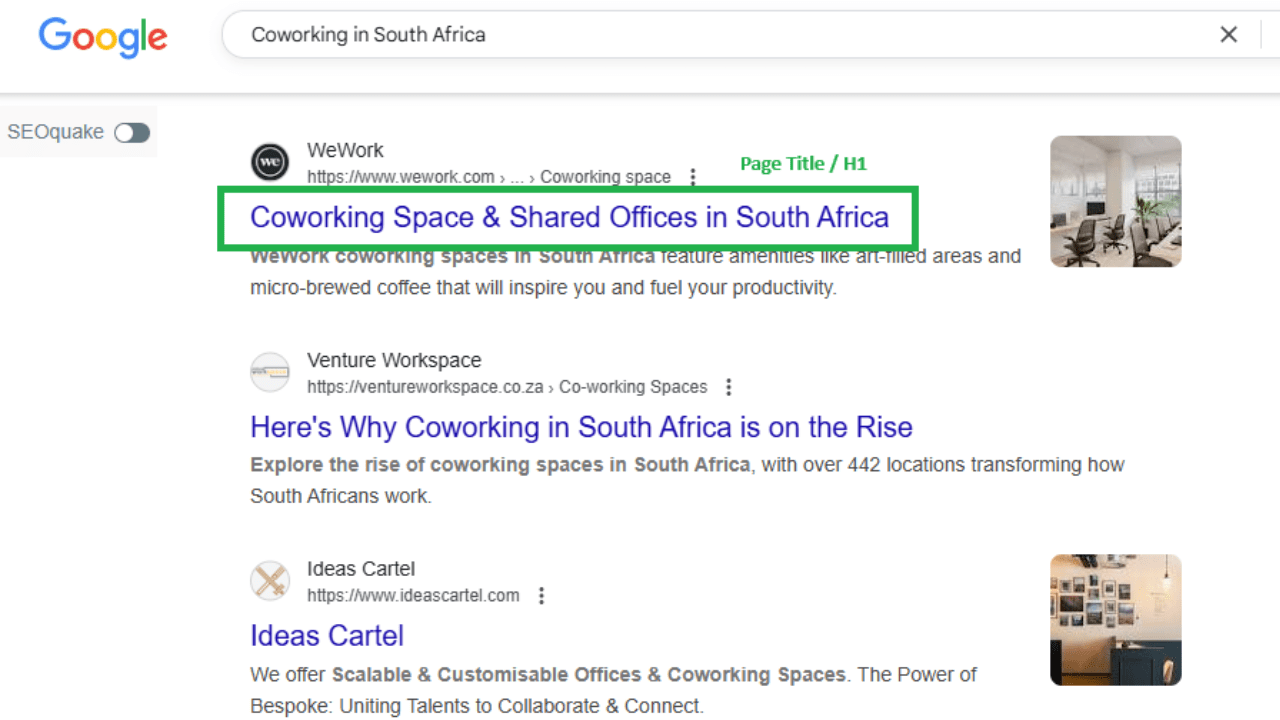
(A screenshot showing the page title / H1 of a page. Note that the Title and H1 of the page can differ slightly, with the H1 having the freedom to be longer.)
Note: Included in this snippet are the page title, URL, and meta description. Other rich results may display additional information, such as ratings, reviews, and amenities.
When writing a page title, it’s important to ensure that it is SEO-friendly for both search engines and humans. Below are some things to keep in mind when writing page titles for your hotel website:
- Write the page title for humans first, as they decide to click on a page or not.
- Use your target keyword in your page title. Place it near the beginning of your title.
- Keep your page title short. The length should ideally be between 50 and 60 characters.
There are other factors to consider, such as naturally incorporating keywords into your page headings (without keyword stuffing) and crafting a catchy title to boost CTR (click-through rate).
Meta Description
The meta description is an HTML tag that provides a brief summary of the web page’s content. Along with the page title and URL, search engines display the meta description in search results. It is an SEO ranking factor that can impact click-through rates as it acts as a “teaser” for the page, providing a concise and enticing summary of the content.
When writing a meta description, consider the following things:
- Include the primary keyword in your meta description, as well as other related keywords.
- Ensure your meta description is the optimal length. Google generally truncates snippets to around 155-160 characters.
- Meta descriptions should entice the reader to click the link and visit your website. Use a clear call to action (CTA) to encourage the browser to open the webpage.
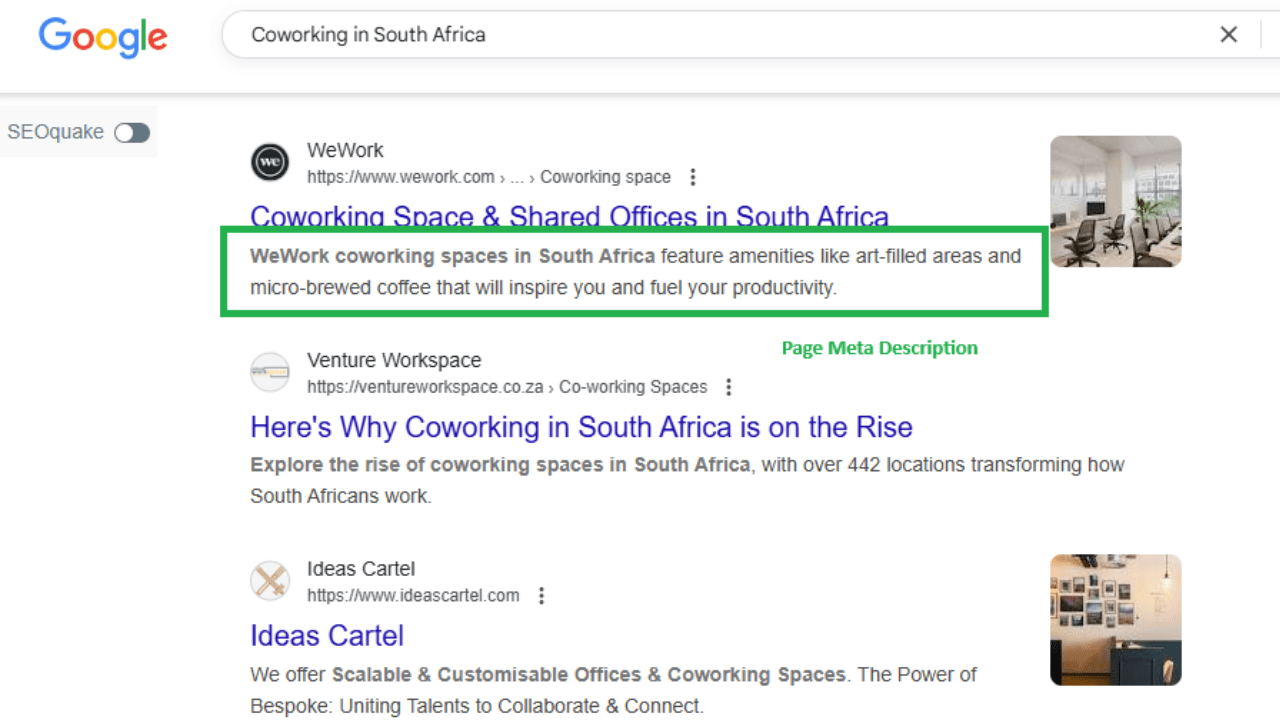
(A screenshot showing the meta description of a page)
Web Page URL
A web page URL is a complete web address used to find particular pages on your website. URLs consist of a domain name and other components necessary to identify specific pages.
Similar to the page title and meta description, the URL appears in the snippet on SERPS and plays a vital role in hotel SEO. Below are guidelines for writing an SEO-friendly website URL:
- Ensure that your URL is straightforward to understand.
- Include your targeted keyword and avoid stuffing extra keywords.
- Separate words with hyphens (dashes) instead of underscores.
- Avoid using connecting or stop words such as “is”, “of”, “for”, “with”, etc.
An example of an SEO-friendly URL is: “https://yourhotel.com/rooms/”, where “your hotel” is the domain name and “rooms” is the specific page.
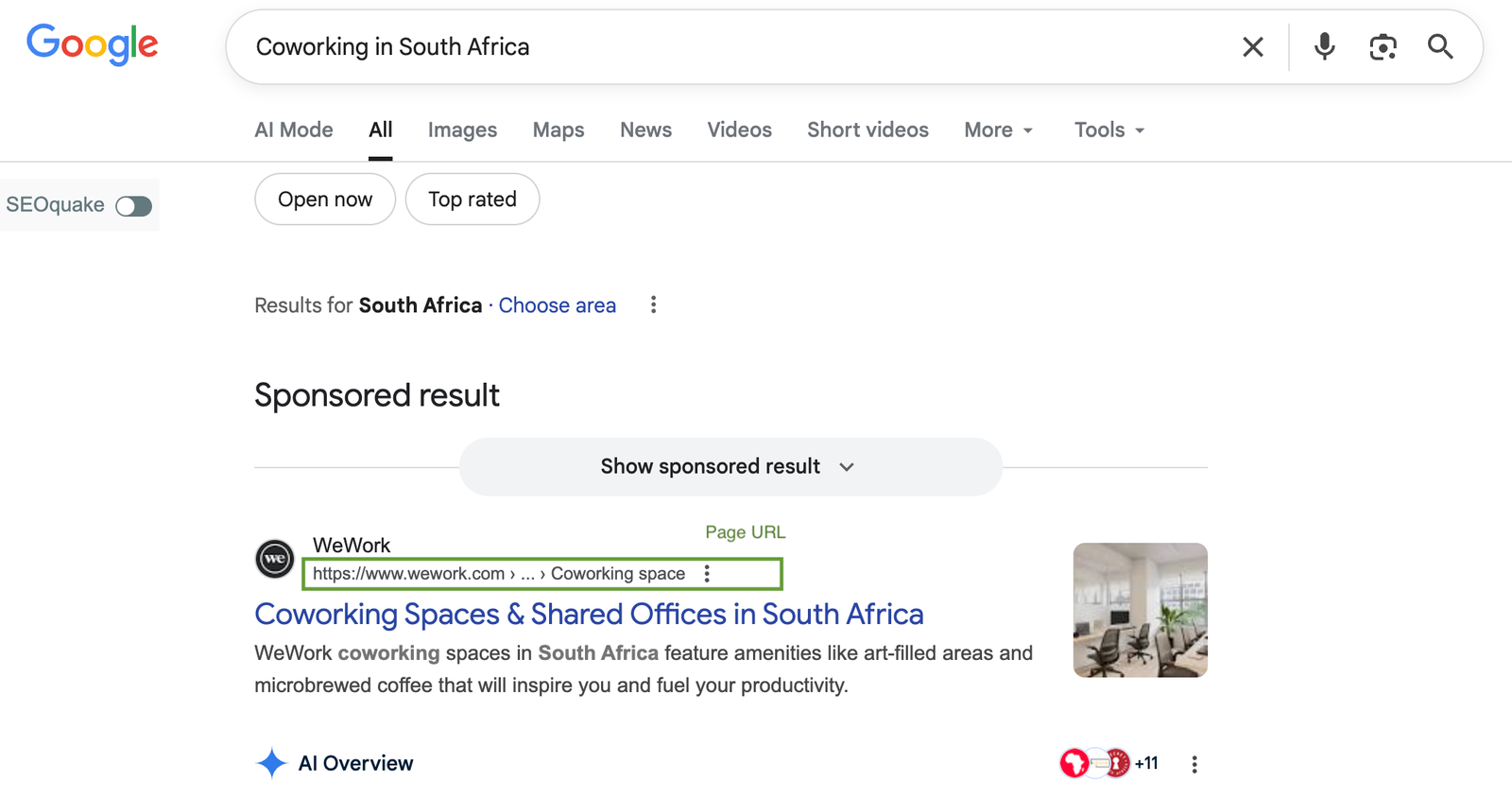
(A screenshot showing the page URL)
4. Create High-Quality Web Content
The next step is content and user experience. Content is one of the most important components of an effective SEO strategy. To rank high for keywords, you need quality content to back it up.
There are several key factors to consider when using content to market your website.
These are detailed below:
- Relevance and Search Intent: Does the content of your website align with your user intent? You can achieve this by focusing on strong, relevant keywords.
- Authority: Your content needs to be in-depth and well-researched. You should ensure that your content answers all the user’s questions.
- Trustworthiness: Search engines must see your information as reliable. You should make sure that the information you provide is factually correct and up-to-date.
- Uniqueness: Original content is crucial for a well-executed SEO strategy. Avoid copying and pasting content from other sources. Search engines penalise duplicate content.
- User-Friendliness: It’s important to consider the user’s experience when creating content. Ensure that your content is digestible and easy to read, and that the page is easy to navigate and loads quickly.
If you meet these principles, search engines such as Google will place greater value on your content. And this may result in your web page ranking higher on the SERPs.
5. Use Headings and Subheadings Properly
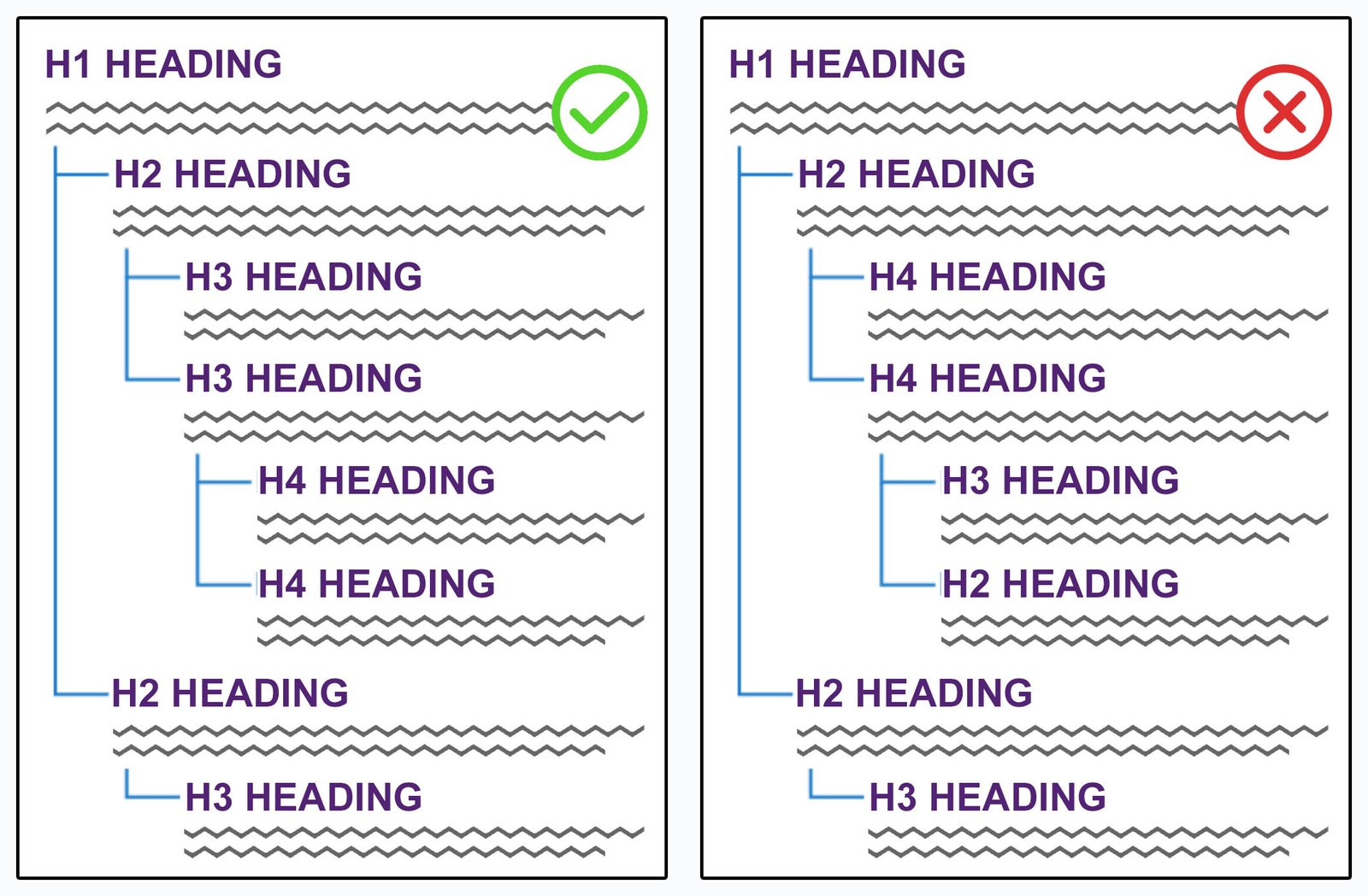
(Example of good heading structure)
Headings and subheadings help users and search engines understand the text on your website. They indicate what parts of your content are important and how they’re linked.
For resort SEO, you want your content to be as easy to read and follow as possible. Having structured content helps with this and provides excellent opportunities to incorporate your keywords effectively.
The HTML tags (H1, H2, H3, and H4) are used to define headings and subheadings. H1 is the most important one; it’s generally the page title, hence it should include your primary keyword.
Below is an example of a good heading structure for a resort website:
- Welcome to the Boston Hotel (H1)
- Our services (H2)
- Rooms (H2)
6. Optimise Your Images
The images used on your website play an important role in the effectiveness of your SEO strategy. Having relevant images will attract users’ attention, spark emotions, and draw them in. This is especially true in the hotel industry, where the property’s appearance is essential.
The most important factors to consider when optimising images for your resort’s website are the image quality, size, and alt text. More on these below.
Image Quality
Image quality can significantly influence users’ perception of your website, brand, and services. For resorts, we recommend using original images as opposed to random stock photos. This way, you can ensure that the images are of high quality and accurately represent what your hotel has to offer.
Image Size
While you don’t want to sacrifice quality, the file size of your images should not be too large, as this will affect the loading speed of your website. A slow website is unfavourable for SEO, as it creates a poorer user experience. Your target audience may quickly move on to another hotel website if your pages are loading slowly.
Image Alt Text
Image alt text is an “alternate text” that appears if an image cannot be displayed. The alt text simply describes what is being shown in the image.
Having image alt texts is important and necessary in cases where:
- An image was to go missing.
- The internet connection is too slow.
- The device being used can’t load images.
- A visually impaired person is using screen readers to consume content.
Additionally, image alt texts provide information to search engines, enabling them to index your web pages more accurately. There is also something called an image search engine, which plays a noticeable role in resort SEO. You will want to rank here as well.

(Side-by-side of the same image with different quality)
7. Leverage Structured Data
Structured data, also known as schema markup, is code that helps search engines better understand the elements on your webpages and how these elements address user intent. Schema is one of the best ways to optimise a website, as it provides users with more relevant information in an organised manner.
There are a range of things that you can add to your website’s schema markup, including your hotel name, street address, and contact details. Other important information to include in the schema markup for your hotel or resort is the number of stars, positive reviews, and room rates.
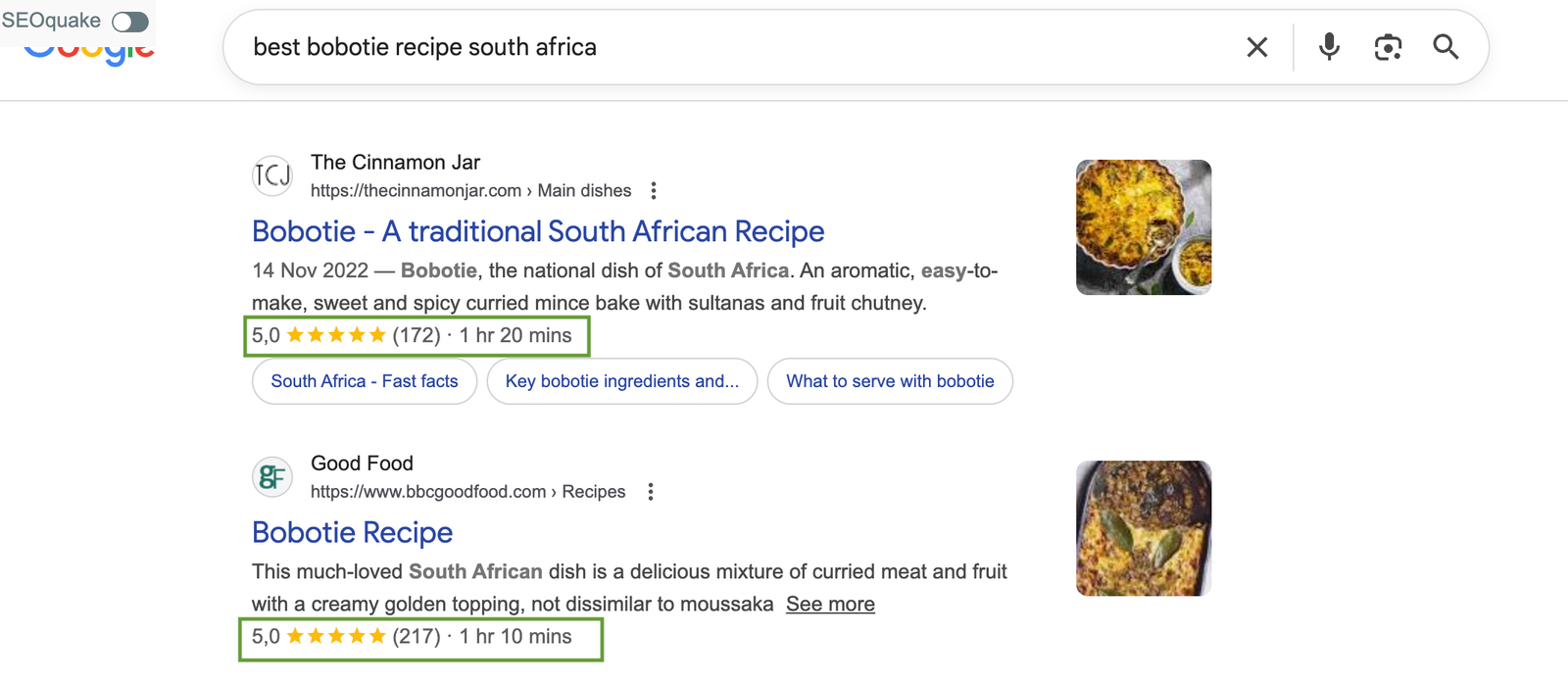
(A screenshot showing search engine results of websites using Schema Markup)
The image above shows an example of how schema markup helps search engines better display a resort’s features, such as star rating and price range, better addressing the user intent.
The key aspect of resort schema is ensuring consistency across all pages. This way, there is no confusion, so search engines can deliver clear and informative results to users.
8. Improve Your Website’s Loading Speed
One of the most important factors influencing your rankings is loading speed. Users are often impatient and will not hesitate to move to another site if pages load too slowly. Slow-loading pages often lead to a high bounce rate, a metric search engines use to rank site performance.
There are several ways to optimise your website’s loading speed. These include:
Compress Your Images
Reduce the file size of images used on your website. This can significantly improve the loading speed of your webpages. To reduce the file size of your images without sacrificing quality, you can use tools like Adobe Photoshop.
Leverage Browser Caching
Browsers cache a significant amount of information, including images and JavaScript files. By leveraging it, when a visitor comes back to your site, the browser doesn’t have to reload the entire page.
Minify Your HTML, CSS, and JavaScript
This process involves minimising the space your code takes up. It includes removing unnecessary spaces, commas, and other characters. By optimising your code, you can significantly increase the loading speed of pages on your hotel website.
Eliminate Render-Blocking Resources
Another reason why your website may be loading slowly is that render-blocking resources are preventing essential parts of your page from displaying in the browser. On a hotel website, you will want certain elements to load before others.
For example, your hotel’s logo, banner, and images should load first before a social sharing plug-in. As such, it is crucial that your website’s code reflects this.
Reduce the Number of Redirects to Your Website
Each time a page on your website redirects to another page, your visitor faces additional time waiting for the HTTP request-response cycle to complete. For this reason, reducing the number of redirects on your webpages can improve the loading speed.
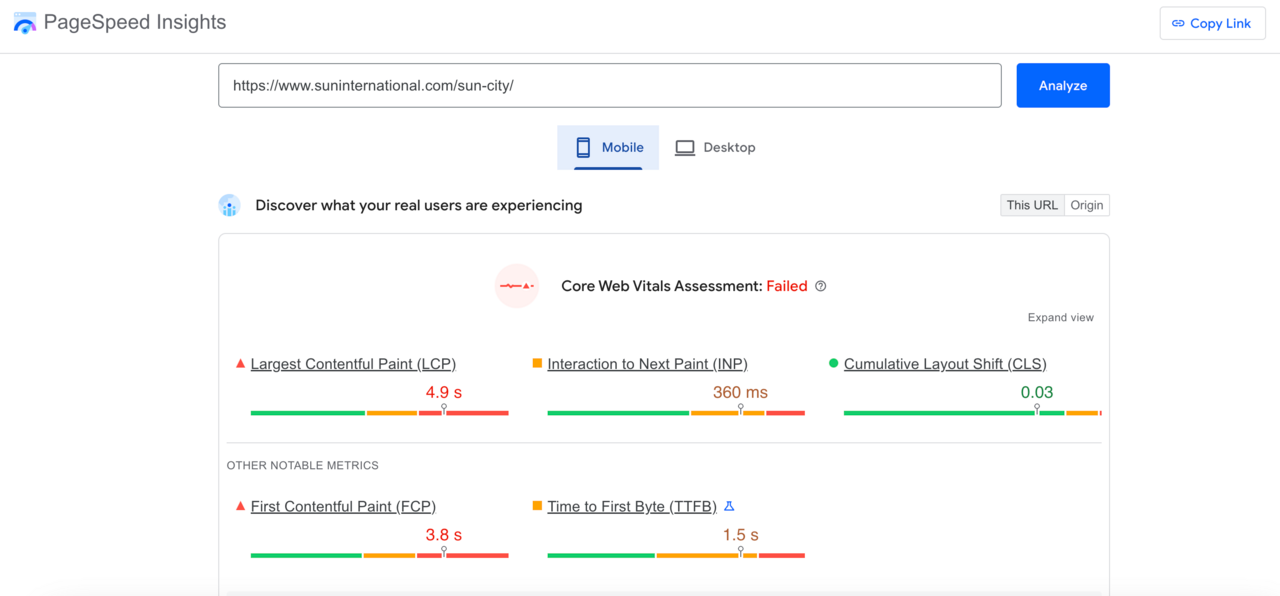
(Screenshot of the core web vitals of a resort)
9. Make Your Hotel Website Mobile-Friendly
Research suggests that around 64% of search traffic comes from mobile devices, with Google getting a big chunk of this traffic. As such, you need to ensure that your hotel website is mobile-friendly.
Below are some things to make your hotel website mobile responsive:
- Optimise your website’s loading speed on mobile devices as well.
- Include the “Viewport Meta Tag”.
- Compress your images and CSS.
- Make your button sizes large enough to work on mobile.
- Use large font sizes.
- Perform mobile testing.
- Add a click-to-call feature.
10. Optimise Your Existing Content
If you already have a website for your resort, you may already have content that could be improved or refreshed. While new content is a key factor in developing strong SEO, optimising the content you already have is also beneficial.
The first step is identifying opportunities. This involves identifying pages, blogs, or articles that are underperforming and have a good chance of ranking higher in SERPs. Pages appearing in the top 10 results bring in the most clicks. So, if you have existing articles that aren’t too far off, these may be worth optimising.
Use a tool like Google Search Console or Google Analytics. These will show important keywords and which ones are driving the most impressions and clicks on your website. Once you have found out which articles are worth improving, it’s time to begin the optimisations.

Below are some basic tips to get you started:
Keep Your Content Fresh
For effective SEO, ensure the information displayed on your webpages is accurate and up-to-date. If it’s not, the page will lose credibility and organic traffic.
Users may be disappointed if they find the information on your website outdated. Perhaps you have dated material, like “best summer resorts in Fiji for 2013”. In this case, you would want to update the date or remove it altogether to keep it evergreen. You will also want to ensure that everything on this page is up to date, including images, prices, and other important information.
Fill the Content Gaps
While updating the existing information, be sure to add any missing details. Check competitor articles that appear higher than yours for your targeted keywords and see what they have that you don’t. From here, decide what you need to add to make your content more comprehensive, ensuring it covers all aspects of the specific problem.
Improve Your On-site SEO
This may come as a no-brainer. However, to optimise your existing content, you will need to focus on improving SEO. This means following the steps mentioned above, starting with your keywords.
Use Google Search Console to analyse keywords driving users to the page you are optimising. You can go back to your article to check how many times you have mentioned these phrases.
You can then increase the frequency of these keywords and add any missing ones as needed. When adding more keywords to your post, make sure that you maintain a natural voice and flow.
Other areas you can improve include images, links, and the heading structure. By meeting the guidelines mentioned above, you can be confident in improving your hotel’s SEO.
Off-Page SEO for Hotels and Resorts
Off-page (or off-site) SEO refers to actions taken outside of your website that impact your rankings in the SERPs. It involves improving search engine and user perception of your site’s authority, relevance, and trust. You cannot control these elements, but you can influence them.
Some off-site factors that influence your resort’s SEO efforts include social media marketing, resort or hotel pay-per-click (PPC) advertising, online reviews, and user-generated content.
11. Build High-Quality Backlinks
Building backlinks is at the heart of off-page SEO. Search engines use the number of backlinks to your web pages to weigh their value and relevance. A great way to acquire more backlinks to your website is through link building.
When it comes to link building, the pages linking back to you should be high-authority sites. This will help pass authority to your page. As search engines see your page being deemed valuable by authoritative sites, it will favour yours as well.
12. Earn Mentions and Citations (Local SEO Boost)
Consistent mentions of your resort name, address, and phone number (NAP) across directories, tourism sites, and local business listings improve local search visibility. List your resort in Google Business Profile, TripAdvisor, Booking platforms, and reputable local directories.
Keep NAP details consistent across every listing and strongly encourage your local collaboration partners to include you in their “places to visit” pages.
13. Manage Online Reviews and Reputational Signals
Reviews influence search engines and travellers. Prompt, genuine reviews from satisfied guests increase click-throughs and conversions. And don’t forget to respond to reviews; it builds trust.
Ask happy guests for reviews (email follow-ups, in-room prompts, QR codes). Reply quickly; thank positive reviewers and professionally address complaints. Monitor review sentiment to spot improvement areas and content opportunities.
14. Encourage and Reuse User-Generated Content (UGC)
UGC, meaning guest photos, videos, blog posts, and social mentions, acts as social proof and creates natural backlinks.
Create branded hashtags and photo contests. Feature guest content on your site and socials (with permission). Turn high-quality UGC into shareable assets for press kits or partner sites.
15. Invest in PR and Content Partnerships
A mention in a travel feature, podcast, or national magazine can send direct bookings and authoritative links. Pitch story ideas tied to unique experiences (wellness retreats, conservation work, foodie events).
Offer fam trips for travel writers and tour operators, and create expert comment pieces about local tourism trends.

Strengthen Your Resort’s Technical SEO
Behind the scenes, technical SEO ensures your website is easily accessible for both search engines and users. Even with great content and design, technical issues can hinder your rankings and negatively impact user experience. For resorts, where first impressions matter, this is an area you don’t want to overlook.
Here are some key areas to focus on:
16. Secure Your Website with HTTPS
Security is a trust signal. Guests are less likely to share details on a site that isn’t secure. Migrating your website to HTTPS not only builds confidence but also gives you a ranking boost.
17. Fix Crawl Errors and Broken Links
Search engines need to crawl your site efficiently. Errors or broken links make it harder for them to index your pages. Regular audits help you spot and resolve issues before they impact visibility.
18. Optimise Your XML Sitemap
Your sitemap acts like a roadmap for search engines. Ensure it’s up-to-date and only includes essential pages. This helps Google and other search engines understand your site’s structure and prioritise the right content.
19. Enhance Site Architecture
Clear navigation is crucial. Guests should be able to find information in just a few clicks, whether it’s room details, facilities, or booking options. A well-structured site also makes it easier for search engines to understand your content.
Note: Technical SEO may seem complex, but establishing these foundations correctly ensures your resort’s website runs smoothly, ranks higher, and provides a seamless experience for visitors.

Take Advantage of Google Hotel Search
In 2015, Google launched an initiative specifically designed for hotels. Through “Book Direct”, searchers can quickly find and book accommodations, bypassing OTAs like Booking.com. This unique interface helps drive more direct traffic to your resort website.
That’s one more reason you should aim to obtain a top spot on the first page of Google’s search engine results pages and Google Map hotel listings.
Here are a few tips to help you enhance your resort’s visibility on Google:
- Get listed on Google My Business.
- Include your resort name and location in your page title, meta description, and URL.
- Ensure your website has high-quality photos to increase conversions and clicks.
- Encourage guests to leave positive Google reviews.
- Provide helpful information, such as hotel descriptions and amenities.

Leverage Local SEO for Hotels
Local SEO involves increasing the visibility of businesses that serve people in their geographic area. Resorts typically operate in a single location, making local SEO a non-negotiable necessity.
Local SEO encompasses a range of tasks, from ensuring a resort’s physical address appears in local Google searches to claiming a business listing. It also involves managing online reviews and ratings, as well as social media engagement, among other tasks.
On your resort website, it’s best to include your target keyword and city name in your title tag, meta description, webpage URL, and header tag. It is also good to start with a citation. A citation is an online reference of your business’s name, address, and phone number (NAP).
Additionally, include details such as a business description, hours of operation, directions, images, videos, and reviews using schema. Search engines will use all this information to evaluate the online authority of your resort and rank you highly for relevant search queries.
FAQs About Hotel Resort SEO Services
Here are some quick answers to the most common questions we get about resort SEO.
What Is SEO in the Hotel Industry?
It’s the process of optimising your resort’s website so it ranks higher on search engines. This marketing strategy helps more travellers find your resort when searching for places to stay.
What Are the 4 Types of Search Engine Optimisation for Hotels?
On-page, off-page, technical, and local SEO. Together, these tactics improve online visibility, site performance, and guest trust. All types of SEO are essential for hotel and resort websites.
Is SEO for Resorts Worth It?
Yes! Strong SEO brings more direct bookings, reduces reliance on OTAs, and ensures your resort stands out to the right audience. That way, you’re making strategic efforts, not guesswork.
How Much Does Hotel Search Engine Marketing Cost?
Pricing for resort SEO firmly depends on your goals, competition, and current website health. Our hotel and resort SEO services are tailored to fit your business’s unique needs and budget.
How Long Does SEO Take for Resorts?
SEO is a long-term investment, but immediate results can be seen depending on the health of your website. Otherwise, you can see early improvements in 3 to 6 months, with stronger, lasting results building over time as strategies take effect.
Resort and Hotel Search Engine Optimisation: Wrapped Up
Just like any other business website, resort websites also require SEO. Having a well-executed strategy can help boost your online visibility, drive more traffic, and increase direct bookings.
As outlined above, many factors influence your hotel SEO. From finding keywords and optimising on-page and off-page elements to leveraging local search and managing a positive brand online, you can improve your site’s performance in many ways.
Keep in mind that SEO is evergreen, so even if you don’t see instant results, the content, keywords, and on-site and off-site elements are all at work. Your desired results may take some time to reflect, so be patient and focus on providing your guests with exceptional resort service.

Matt Davison is the founder of Travel Tractions and one of the most trusted names in tourism marketing.
Since 2009, he has helped tour operators, hotels, and travel publishers win in search. His team’s work includes growing TravelLocal’s AI citations 64x in 180 days and driving 500k monthly visits for Vibescout through programmatic SEO in less than a year.
Matt was early to GEO (getting travel brands cited by AI tools like ChatGPT) and now speaks and writes on where travel search is heading.
After travelling the world for 10 years, he now works from Cape Town and San Francisco